Writing Metacognition: How to Think About Your Own Writing
Writing metacognition is the habit of thinking about how you write while you write: deciding what the task needs, noticing whether the draft is doing it, and judging the result so the next piece is better. Skilled writers do this almost automatically. Everyone else can learn it as a short routine of planning, monitoring and evaluating. This guide explains the idea in plain terms, shows what the research says, and gives you a routine you can use for IELTS and TOEFL essays, for work documents, or in a classroom.
WritinglabBuild More Thoughtful Writing HabitsWriting Lab offers writing feedback and grammar checking to help students and educators improve drafts and make assessment more manageable.Visit
TL;DR
- Metacognition in writing is “thinking about thinking”: knowing the task, choosing strategies, and checking your own draft against clear criteria.
- Across studies of university EFL writers, planning, monitoring and evaluating strategies track closely with writing scores, and planning shows the strongest link in one large study.
- Use a three-phase routine: plan before drafting, monitor while drafting, evaluate after drafting, and write down what you will change next time.
- For IELTS and TOEFL, a few minutes of planning and a rubric-based self-check are the most practical habits to build.
- Teachers get the best results by teaching the strategies explicitly and building evaluation and revision into the assignment itself.
Table of Contents
- What metacognition means when you write
- What the research shows
- A before, during and after routine
- Strategies worth using
- Using metacognition for IELTS and TOEFL writing
- For professionals and other writers
- For teachers: teaching the strategies explicitly
- Our perspective
- Put the routine into practice
- FAQ
- Sources
What metacognition means when you write
The term goes back to psychologist John Flavell, who described it in 1979 as awareness of your own thinking and the processes that run it. In writing research, it is usually split into two parts, as summarized in a 2022 validation study of Chinese university writers:
- Metacognitive knowledge: what you know about yourself as a writer (your habits, strengths and weak spots), about the task (genre, audience, purpose), and about strategies (which methods suit which problem).
- Metacognitive regulation: what you do with that knowledge, namely planning, monitoring and evaluating.
A simple example: you are asked to write a 250-word opinion essay. Knowing that you tend to drift off topic is knowledge about yourself. Knowing that the task needs a clear position in the first paragraph is knowledge about the task. Pausing after each paragraph to ask whether it supports your position is regulation, specifically monitoring.
Writing Commons, a writing-instruction site, describes the idea as thinking about thinking, and lists the juggling writers do: organizing ideas, expressing them clearly, choosing words, and evaluating the text against several criteria during and after drafting. Metacognition is what keeps all of that from becoming noise.
What the research shows
Most of the evidence comes from studies of English learners at universities, and it points in a consistent direction.
- In a 2022 study of 503 Chinese university students, all six metacognitive components (person, task, strategies, planning, monitoring and evaluating) were significantly correlated with writing performance. Together they accounted for 65% of the variance in writing proficiency, and planning had the greatest effect.
- A 2019 study of 882 students at eight Chinese universities found that all six parameters correlated positively with writing, and that regulation predicted writing proficiency beyond what knowledge alone explained. In plain terms: knowing about strategies helps, but using them helps more.
- A 2021 study of 664 students extended the model to eight strategies, adding information management and debugging, and found they explained about 87% of the variance in academic writing scores.
A correlation is not proof of cause, so it helps to look at intervention studies too. A 2026 meta-analysis of 17 experimental and quasi-experimental studies (2,797 learners) found a positive pooled effect of 0.95 on writing skills, with wide variation between studies. After adjusting for small-study effects, the estimate came to about 0.55, still a meaningful gain. The practical lesson is that results depend on how well the strategies are taught and practiced, which is why the routine below is specific.
One more finding is worth knowing. A study of Croatian high school students found that most agreed they used planning and during-writing strategies, but post-writing strategies were applied less consistently. Evaluation is the phase people skip once the draft feels finished, and it is the phase where the learning happens.
A before, during and after routine
The three-phase model from Papleontiou-Louca (2003), as summarized in that Croatian thesis, gives a clean structure. Here it is as a working routine.
| Phase | The question to ask | What to do |
|---|---|---|
| Before (planning) | What is this for, who reads it, and how will I approach it? | Write the purpose and audience in one line. Sketch a mind map or outline. Pick a strategy for the part you find hardest. |
| During (monitoring) | Is this paragraph doing its job? | Pause after each paragraph and check it supports the main point. Check global features (content, organization) first, local ones (grammar, word choice) second. |
| After (evaluating) | What worked, what didn’t, and what will I change next time? | Reread against a rubric or checklist. Revise the biggest problems first. Note one goal for the next piece. |
A few notes on making each phase work.
Planning: spend the minutes up front
Planning is the strongest single lever in the 2022 study above, and it is also the step people most often skip under time pressure. Decide your purpose, audience and main points before the first sentence. Even a rough visual organizer counts, because it forces you to see how ideas connect before you commit to sentences.
Monitoring: check meaning before polish
Monitoring means checking while you write, not after. The useful habit is ordering your checks. First ask global questions: is each paragraph relevant, and does the order make sense? Only then ask local ones about grammar and vocabulary. Fixing commas in a paragraph you will delete is wasted effort. If you want a method for the global check, our guide on how to evaluate essay structure walks through it step by step.
Evaluating: judge the draft against criteria, then set a goal
Evaluation is easier when the criteria are written down. A genre-specific question such as “Is my position stated clearly?” turns a vague feeling into a yes or no. The research summary recommends reflecting on strengths and weaknesses afterward and setting a goal for the next piece. Our guide to writing self-assessment shows how to judge your own draft this way, and the pass-by-pass revision method shows what to fix in which order.
Strategies worth using
Mind maps, used more than once
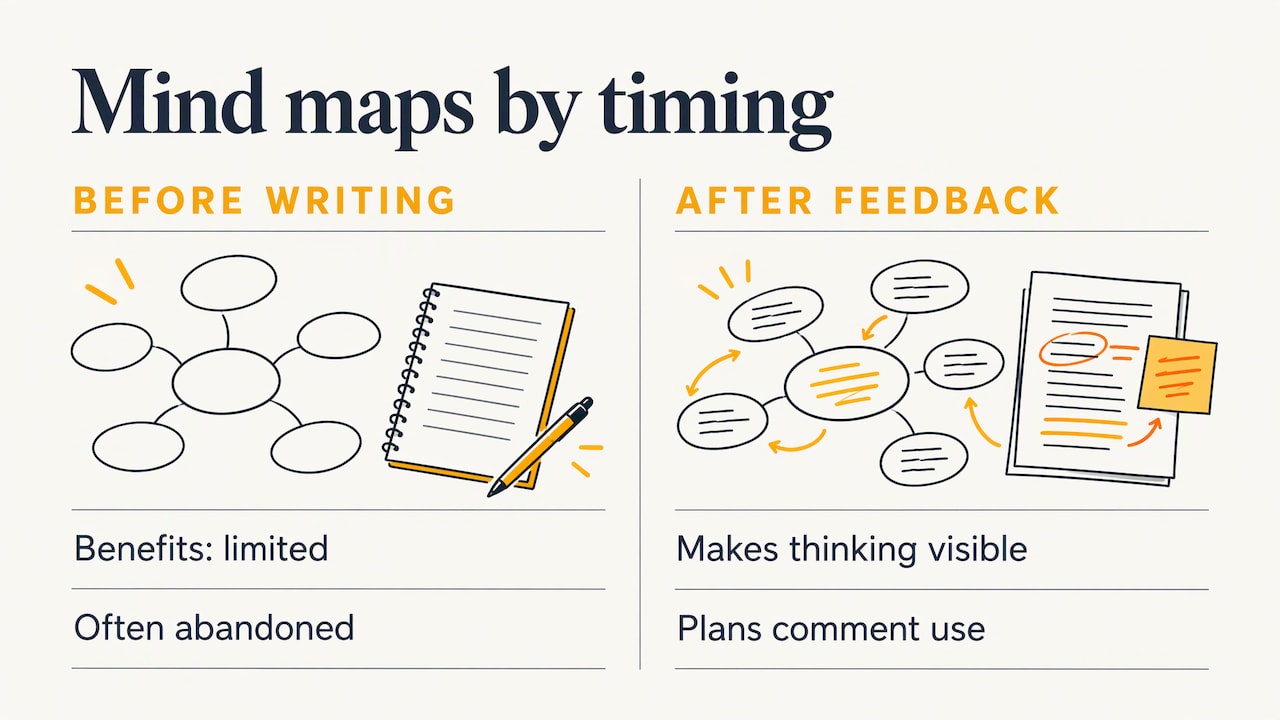
Most people draw a mind map before writing and then abandon it. A 2023 case study of sixteen first-year writing students found that the first, pre-writing map had limited benefits, while a second map made when responding to feedback became a space where students made their thinking visible and planned how to apply the comments. Try it: after you get feedback, map the draft, the comments, and your next steps on one page. Line-by-line editing works in a similar way, because it forces each revision choice into the open; line editing as a way to learn writing is one angle on that.
The DEAL cycle
The WAC Clearinghouse chapter on reflecting throughout your writing process offers a memorable reflective cycle:
- Define the situation: what are you being asked to do, and for whom?
- Explore opportunities: what approaches could you take?
- Act on your choices: draft with a chosen approach.
- Look and Learn: what happened, and what will you do differently?
The authors suggest treating the writing process as an experiment. When something is not working, try another approach and learn from the result. That framing lowers the stress of getting it right the first time.
Checking against exemplars and rubrics
Comparing your work with a strong example, against stated standards, builds knowledge about the task and helps you monitor yourself. A Hong Kong teaching resource on exemplars for IELTS writing recommends exactly this: write the task, then analyze and compare an exemplar with your own response against the assessment criteria.
Using metacognition for IELTS and TOEFL writing
Exam writing is metacognition under a clock. The same three phases apply, only compressed.
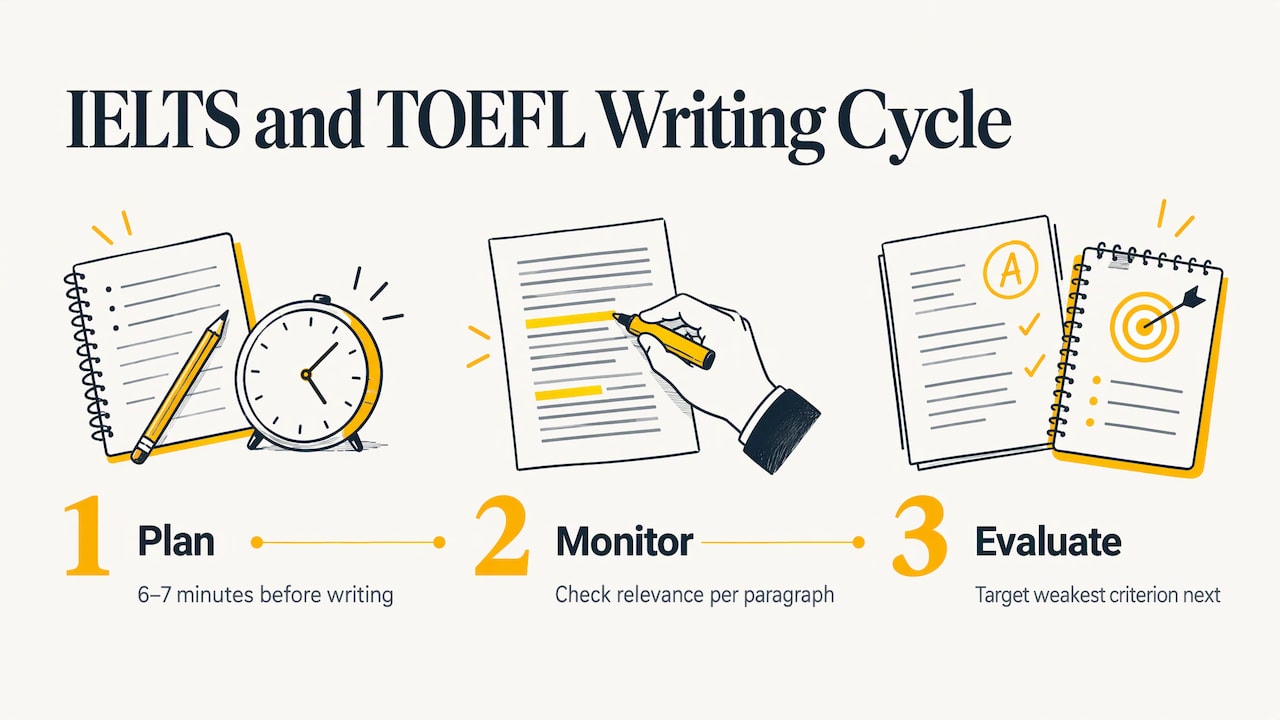
Plan before you write. Collins’ course materials for IELTS writing advise spending 6 to 7 minutes analyzing the question, generating ideas and planning, and call starting to write immediately a typical mistake that reduces coherence. They also recommend pair and group work in which learners explain how they approached a task, which develops exam-strategy awareness.
Monitor in short bursts. After each body paragraph, take a few seconds to confirm it answers the question and supports your position. This is the same relevance check described above, just faster. In a study of Indonesian TOEFL iBT test-takers, monitoring and evaluating played a pivotal role in how candidates handled the integrated reading, listening and writing task, alongside strategies for organizing, connecting and selecting source information.
Evaluate between practice essays, not just at the end. The real payoff comes after practice. Score each practice essay against the band descriptors, name the single weakest criterion, and set that as the focus of the next essay. A useful practice log has four lines: the task, your plan time, what monitoring caught, and one goal. Our IELTS writing practice plan lays out a step-by-step approach to raising your band.
For professionals and other writers
You do not need an exam to benefit. The same questions sharpen emails, reports and proposals:
- Before: Who is reading this, what should they do afterward, and what is the one point they must remember?
- During: Does this paragraph move the reader toward that action? Is the most important information early?
- After: What would a skeptical reader question? What worked in this document that I should repeat?
The DEAL cycle suits project-sized writing: define the situation at the start, and use the Look and Learn step to record what you would change before the next report. Writers who feel stuck can use the experimental mindset from the WAC chapter: try a different structure, see how it reads, and keep what works.
For teachers: teaching the strategies explicitly
Strategies do not appear just because students write more. The evidence favors teaching them directly and giving students something concrete to reflect on.
- Process-genre instruction. In a 2022 study of 72 first-year undergraduates, think-aloud data showed students’ monitoring shifting from surface-level word and grammar control toward control of the whole text, with more planning time before writing.
- Build evaluation into the prompt. Huang and Zhang advise that weaker strategies such as evaluation deserve extra attention, with explicit evaluation and revision requirements in writing prompts and more substantial revising tasks.
- Strategy instruction with genre tools. The Supporting Strategic Writers project reported large effects on writing quality and positive effects on motivation factors such as self-efficacy, using genre-based organizers and genre-specific rubrics for self-evaluation and peer review.
- Feedback that students act on. A one-semester self-regulated learning feedback intervention improved organization, vocabulary and content scores, along with students’ reported use of goal-oriented monitoring and feedback handling.
- Train and motivate together. A study of 150 EFL students assessed with IELTS writing tests found a positive but low correlation between strategy use and performance, and concluded that teachers should both train and motivate students. Students there found outlining, peer review and templates helpful for structure.
For classroom routines, see our guides on feedback literacy, supporting peer review, and using rubrics for peer assessment. A clear rubric is the backbone of student self-evaluation, and our step-by-step guide to making a rubric shows how to build one.
Our perspective
Metacognition sounds abstract until you see where it breaks down. Students plan a little, write a lot, and then hand in the draft without ever asking whether it did its job. The missing piece is almost always a clear set of criteria to judge the draft against, and a prompt to look back.
That is why we build Writing Lab around assessment and feedback together. Essay grading, rubric generation, writing feedback and grammar checking give a writer something specific to compare their draft with, which is exactly what the evaluation phase needs. For teachers, the same tools take over repetitive marking so more time goes to teaching the strategies, not just scoring the results.
Our advice is simple: pick one phase, make it a habit, and name a single goal for the next piece of writing. Small, repeated reflection beats a one-time lecture on strategy.
Sabba
Put the routine into practice
Writing Lab brings essay grading, rubric generation, writing feedback, grammar checking, and IELTS and TOEFL practice into one platform, with a free access tier and paid monthly or yearly plans. Students can use it to check a draft against clear criteria and decide what to change next, and teachers can use it to assess work and give actionable feedback while spending less time marking. Start with our IELTS writing practice guide or explore the platform at writinglab.io.

FAQ
What is metacognition in the writing process?
It is awareness and control of your own thinking while you write. That means knowing the task and your own habits, then planning before drafting, monitoring during drafting, and evaluating afterward. It is often summed up as thinking about thinking.
What are good metacognitive strategies for writing?
Before writing, draw a mind map or visual organizer and note your purpose and audience. While writing, pause to check that each paragraph supports your main point. Afterward, reread against a rubric, reflect on strengths and weaknesses, and set a goal for your next piece.
Does metacognition really improve writing scores?
Studies of university English learners link planning, monitoring and evaluating strongly with writing proficiency, and a 2026 meta-analysis of 17 intervention studies found a positive effect on writing skills. Results vary with how the strategies are taught, so regular practice with feedback matters.
How can I use metacognition for IELTS or TOEFL writing?
Spend the first few minutes analyzing the question and planning, check each paragraph against your position as you write, and score every practice essay against the band criteria. Then pick one weak criterion as the goal for the next essay.
How can teachers teach metacognitive strategies?
Model the strategies aloud, give genre-specific rubrics and organizers, and build evaluation and revision requirements into assignments. Pair and peer work helps students explain their approach and compare it with others.
Sources
- A questionnaire-based validation of metacognitive writing strategies (2022)
- The role of metacognitive knowledge and regulation in writing (2019)
- Validation of metacognitive academic writing strategies (2021)
- Self-Regulation and Metacognition, Writing Commons
- The Effectiveness of Metacognitive Strategies for Improving Writing, meta-analysis (2026)
- The Effectiveness of Metacognitive Strategies for Improving Writing, article page
- Metacognitive Strategies and the Use of ChatGPT in EFL
- Mind maps and metacognition in writing pedagogies
- Reflecting Throughout Your Writing Process, WAC Clearinghouse
- About Writing for IELTS, Collins
- Problems Faced and Strategies Applied by Test-Takers in TOEFL iBT integrated writing
- Facilitating L2 writers’ metacognitive strategy use, Frontiers in Psychology
- Facilitating L2 writers’ metacognitive strategy use, PMC
- Supporting Metacognition in Writing Strategy Instruction
- Examining the effects of self-regulated learning-based teacher feedback
- Strategies, Self-Efficacy, and Performance in EFL writing