IELTS Band Descriptors: How Examiners Score Your Writing
IELTS band descriptors are the examiners’ marking scales. For Writing and Speaking, each response is scored on four criteria, and the descriptor for each band says what performance earns that score. If you know what each criterion rewards, you can mark your own practice essays against the same standard and fix the specific weakness that holds your band down. That is also how we recommend preparing: judge every draft against the descriptors, not against a general feeling that it “sounds good.”
This guide explains the Writing descriptors in plain terms, shows how the scores are combined and rounded, and ends with a way to put the descriptors to work.
Writinglabwritinglab.ioPractice IELTS Writing With Clearer FeedbackWriting Lab offers AI-powered writing feedback to help you identify weaknesses and improve your IELTS practice essays.Visit
TL;DR
- Writing is marked on four equally weighted criteria: Task Achievement (Task 1) or Task Response (Task 2), Coherence and Cohesion, Lexical Resource, and Grammatical Range and Accuracy.
- A script must fully fit the positive features of a band to receive it, and negative features limit the score.
- Task 2 counts twice as much as Task 1 in your Writing score.
- The overall band is the average of the four skills, rounded to the nearest half band: 6.25 becomes 6.5, and 6.75 becomes 7.0.
- The current Writing descriptors have been in use since May 2023. There is no pass or fail in IELTS.
Table of Contents
- What band descriptors are and what they cover
- The four Writing criteria
- How examiners decide which band you get
- How the Writing score is built
- From four skills to one overall band
- What bands 5, 7 and 9 look like in Writing
- The Speaking criteria
- Did the descriptors change?
- Turning the descriptors into a practice routine
- Practice against the criteria with Writing Lab
- Our perspective
- FAQ
- Sources
What band descriptors are and what they cover
IELTS tests four skills: Listening, Reading, Writing and Speaking, in both the Academic and General Training versions, as the official IELTS scores guide explains. Listening and Reading are scored by counting correct answers. Writing and Speaking need a human judgment, so examiners work from detailed band descriptors. According to the IELTS teacher’s guide, they award a score for each of four criteria in each of those two sections, and the descriptors explain the performance needed for a particular band.
The bands themselves run from 0 to 9. The same scores guide labels them: 9 Expert, 8 Very good, 7 Good, 6 Competent, 5 Modest, 4 Limited, 3 Extremely limited, 2 Intermittent, 1 Non-user and 0 for a candidate who did not attempt the test. You receive whole and half bands, and no pass or fail exists. Each institution or employer sets the score it requires.
The four Writing criteria
The IELTS Writing resources page lists the four criteria. Each one is worth 25% of the mark for a task, according to the British Council’s assessment guidance.
| Criterion | What the examiner is judging | Where it goes wrong |
|---|---|---|
| Task Achievement (Task 1) | How fully, appropriately, accurately and relevantly you fulfill the task, and whether the format suits it | Missing an overview, listing every number, ignoring the purpose of a letter |
| Task Response (Task 2) | How fully you answer, how well main ideas are extended and supported, and how clear your position is | Answering only half the question, unsupported claims, a position that shifts |
| Coherence and Cohesion | Organization, logical development, and the linking of information and ideas | Paragraphs with no clear point, heavy or mechanical linking words |
| Lexical Resource | The range, accuracy and appropriateness of your vocabulary | Repeating the same words, rare words used wrongly |
| Grammatical Range and Accuracy | The range and appropriateness of your grammar, and how accurate your sentences are | Only simple sentences, or complex ones that are mostly faulty |
Two practical details sit beside the criteria. The key assessment criteria document sets a minimum of 150 words for Task 1 and 250 words for Task 2, and says scripts may be penalized if they are partly or wholly plagiarized, or not written as full connected text, such as bullet points or note form.
Task 1 and Task 2 in each version of the test
In the Academic test, Task 1 asks you to describe a graph, table, chart or diagram in at least 150 words in about 20 minutes, and Task 2 asks you to discuss a point of view, argument or problem in at least 250 words in about 40 minutes, per the Academic Writing format page. In General Training, Task 1 is a letter, with achievement judged by how well the letter achieves its purpose, and Task 2 is an essay, according to the General Training Writing page. The criteria are the same in both, so the same habits transfer.
How examiners decide which band you get
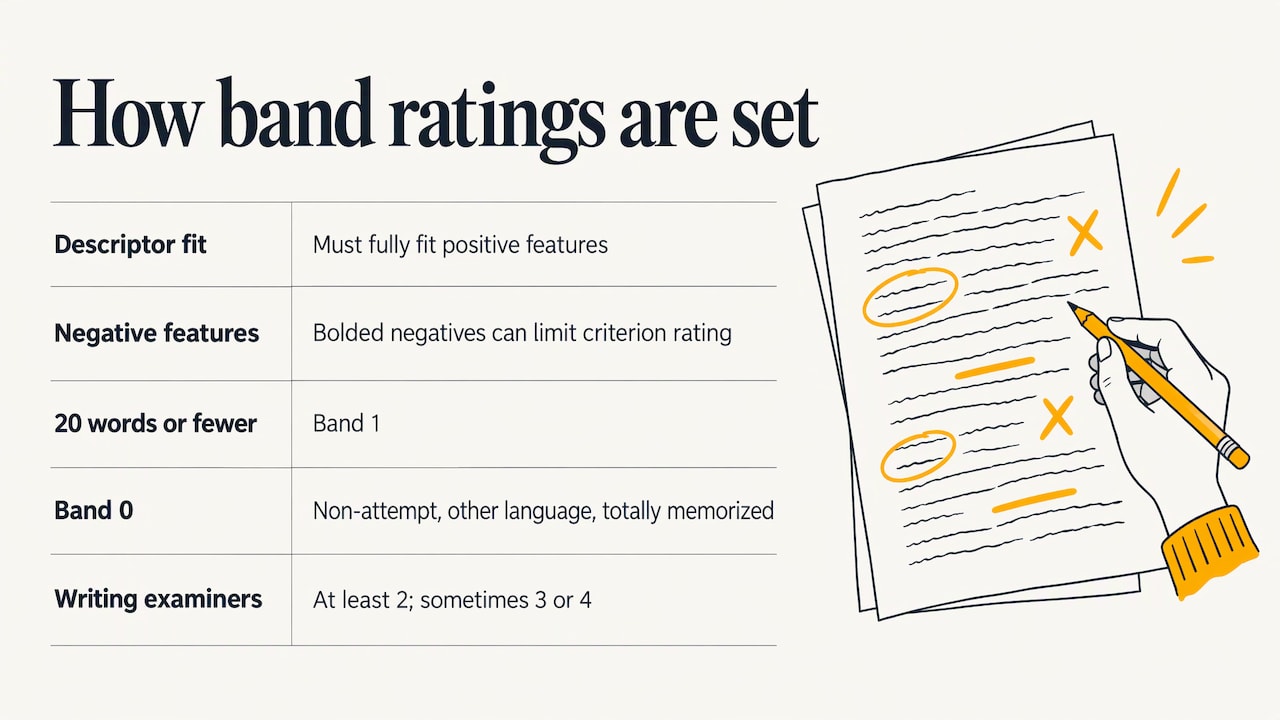
The rule that surprises most candidates is this: per the official Writing band descriptors, a script must fully fit the positive features of the descriptor at a particular level, and bolded text marks negative features that limit a rating. So a band is not an impression. A script that does most things at Band 7 level but contains a Band 5 problem in one criterion can be held back in that criterion.
The same document sets the floor. Responses of 20 words or fewer are rated Band 1. Band 0 is reserved for a non-attempt, writing in another language throughout, or an answer proven to be totally memorized.
The people applying the scale are trained. The British Council’s page on how IELTS is assessed describes qualified, intensively trained and monitored examiners. IELTS Australia’s band score page notes that Writing is marked by at least two examiners, and sometimes three or four. A quality-and-fairness publication from IELTS adds that new examiners are monitored three times in their first year and standardized and recertified every two years.
How the Writing score is built
Each task is assessed independently. The IELTS scoring page states that the four criteria are weighted equally, that the task score is their average, and that Task 2 carries more weight than Task 1. IELTS New Zealand spells it out: Task 2 is worth twice as many marks as Task 1.
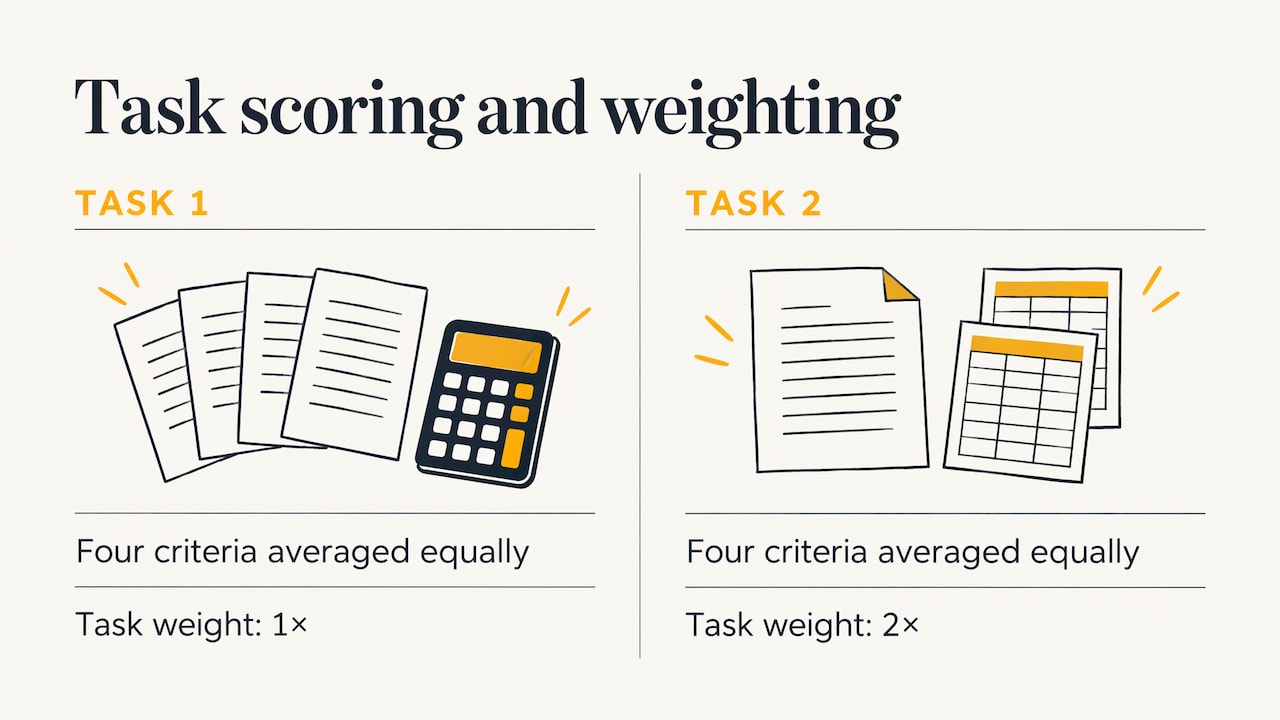
The consequence for planning your 60 minutes is clear. Task 1 deserves a precise, complete answer, but a weak Task 2 costs you more. Many candidates spend too long polishing the chart description and rush the essay.
From four skills to one overall band
Your overall band is the average of the four section scores, rounded to the nearest half band. The IELTS scoring page gives the rule: an average ending in .25 rounds up to the next half band, and one ending in .75 rounds up to the next whole band. Its examples include 6.25 to 6.5 and 3.875 to 4.0, while 6.125 rounds down to 6.0.
Here are two worked examples:
- Listening 7.0, Reading 6.5, Writing 6.0, Speaking 6.5. The total is 26.0, the average is 6.5, and the overall band is 6.5.
- Listening 7.0, Reading 6.5, Writing 6.0, Speaking 6.0. The total is 25.5, the average is 6.375, which is closer to 6.5 than to 6.0, so the overall band is 6.5.
The second example shows why a single half band in Writing can decide whether you reach a required overall score. Listening and Reading are scored by raw marks out of 40, converted to bands, and the conversion differs by test. According to the British Council, Band 7.0 needs 30 to 32 marks in Academic Reading and 34 to 35 in General Training Reading.
What bands 5, 7 and 9 look like in Writing
The full descriptors are worth reading in the official PDF. In summary, the May 2023 version describes three useful reference points.
Band 5. Task 1 is generally addressed but with limited detail. Organization is not wholly logical. Vocabulary is limited but minimally adequate, and attempts at complex sentences tend to be faulty.
Band 7. In Academic Task 1 there is an overview, with key data appropriately categorized and trends identified. Organization is logical, with some less common vocabulary, and a variety of complex structures with frequent error-free sentences.
Band 9. Task requirements are fully and appropriately satisfied, with extremely rare lapses.
The jump from 5 to 7 is mostly about control. At Band 5 you attempt things and miss. At Band 7 you attempt more varied things and get most of them right. That is why adding more difficult grammar without checking accuracy rarely moves a score.
The Speaking criteria
Speaking uses its own four criteria: Fluency and Coherence, Lexical Resource, Grammatical Range and Accuracy, and Pronunciation. The official Speaking band descriptors say you are rated on your average performance across all parts of the test, with descriptors from Band 9 down to 0. Lexical Resource and Grammatical Range and Accuracy mean the same thing as in Writing, so the vocabulary and sentence habits you build for essays help here too.
Did the descriptors change?
The Writing descriptors you should study were introduced operationally in May 2023, after a four-year project by the test partners. The November 2023 research summary reports a final study of 1,000 responses marked twice by 100 examiners. It found minimal effect on scores: 63% of responses had no change or a half-band increase, and just under 20% dropped half a band. The four criteria and the 0 to 9 scale stayed the same. The British Council’s June 2026 guide confirms the scale has stayed consistent for three decades.
Turning the descriptors into a practice routine
Reading descriptors is easy. Applying them to your own writing is the hard part, because you wrote the essay and you know what you meant. A method that works:
- Mark one criterion at a time. Read your essay four times, once per criterion, instead of forming one overall impression.
- Find the limiting feature. Look for the lowest band whose negative features appear in your text. That criterion sets your ceiling.
- Fix one pattern. For example, if sentences are all simple, rewrite three of them as complex sentences and check that they are accurate. Our guide to sentence variety shows how.
- Rewrite, then re-mark. The same essay, revised, teaches more than a new essay with the same habits.
- Respect the numbers. Check the 150 and 250 word minimums and write in full connected paragraphs.
For a longer plan, see our IELTS Writing practice guide. To get better at judging a draft without a teacher, read how to judge your own writing. Teachers building classroom marking tools can start with how to make a rubric and the choice between analytic and holistic rubrics. The IELTS scale is analytic: four separate scores, averaged.
Practice against the criteria with Writing Lab
Writing Lab is an AI-powered platform with tools for essay grading, writing feedback, grammar checking, and IELTS and TOEFL practice. You write a practice response, get feedback you can act on, revise, and write again. Teachers can use the same tools to assess student work and spend less time marking. Learn how AI grading for essays works, or start at Writing Lab.

Our perspective
Most students we hear from treat the band descriptors as a document to read once. We think they work better as a checklist you return to after every draft. The descriptors are specific: they name what a Band 6 sentence looks like and what separates it from Band 7.
That specificity is what makes feedback useful. “Improve your grammar” changes nothing, while “your complex sentences are attempted but faulty, so your Grammatical Range and Accuracy sits at Band 5” tells you what to practice tomorrow.
This is the idea behind Writing Lab. We build tools for essay grading, rubric generation, writing feedback and IELTS and TOEFL practice so that learners and teachers can get criterion-level guidance quickly and spend their time on the revising and teaching that actually raise a score.
Sabba
FAQ
What are IELTS band descriptors?
They are the published marking scales examiners use for Writing and Speaking. Each skill is judged on four criteria, and each band from 9 to 0 has a description of the performance it requires. You can use them to understand your level and to see what the next band demands.
Is 6.25 rounded to 6.5 in IELTS?
Yes. The overall band is the average of the four section scores, and an average ending in .25 rounds up to the next half band, so 6.25 becomes 6.5. An average ending in .75 rounds up to the next whole band, so 6.75 becomes 7.0. An average of 6.125 rounds down to 6.0.
Do the four Writing criteria count equally?
Yes. Each is worth 25% of the mark for a task. The two tasks are not equal, though: Task 2 is worth twice as much as Task 1 in your Writing score.
Is there a pass mark in IELTS?
No. The scores guide states there is no pass or fail. You receive band scores from 0 to 9 in whole and half bands, plus an overall band. The score you need depends on the university, employer or immigration body asking for it.
Who marks my Writing test?
Qualified, trained examiners who work to the band descriptors. Writing is marked by at least two examiners, and sometimes three or four, according to IELTS Australia’s page on band score calculation.
Sources
- Teacher’s guide to IELTS
- Your guide to understanding and using IELTS scores
- IELTS Writing test preparation resources
- IELTS Assessment Criteria and Band Score Descriptors, British Council
- IELTS Writing key assessment criteria
- IELTS Academic: Writing test format
- IELTS General Training: Writing test format
- IELTS Writing band descriptors
- How IELTS is assessed, British Council
- Calculate IELTS band scores, IELTS Australia
- Ensuring quality and fairness in international language testing
- IELTS scoring in detail: band scores explained
- IELTS Writing band scores and what they mean, IELTS New Zealand
- IELTS Speaking band descriptors
- IELTS Writing Scales Review and Update summary overview
- Guide for organisations, British Council, June 2026