How to Improve Paragraph Structure: A Step-by-Step Method
A well-built paragraph does one job: it makes one point and proves it. To improve paragraph structure, decide the single idea first, state it in a topic sentence, support it with evidence, explain why that evidence matters, then fix the order and wording of the sentences so each one leads into the next. This guide walks through that routine, shows a before-and-after rewrite, and covers the sentence-level fixes that make a paragraph read smoothly. Writing Lab’s grammar checking and writing feedback tools can run that same check on your own draft, paragraph by paragraph.
WritinglabStrengthen Every ParagraphUse Writing Lab’s writing feedback and grammar checking tools to review paragraph structure and make your sentences clearer.Visit
TL;DR
- Give every paragraph one controlling idea, stated early in a topic sentence. If a paragraph has two ideas, split it.
- Build the body as point, evidence, explanation (the PIE pattern), then close with a takeaway sentence.
- Aim for roughly four to six sentences in a first draft, then adjust in revision.
- For flow, start sentences with information the reader already knows and end them with the new information.
- Fix awkward sentences last, and read them aloud to find them.
Table of Contents
- Start with one idea per paragraph
- The anatomy of a strong body paragraph
- How long should a paragraph be?
- Choose a pattern that fits the point
- Make the sentences flow
- A worked example: before and after
- Reassemble a paragraph that will not work
- Improve sentence structure inside the paragraph
- A revision checklist you can reuse
- If you are preparing for IELTS or TOEFL
- Get paragraph-level feedback with Writing Lab
- Our perspective
- FAQ
- Sources
Start with one idea per paragraph
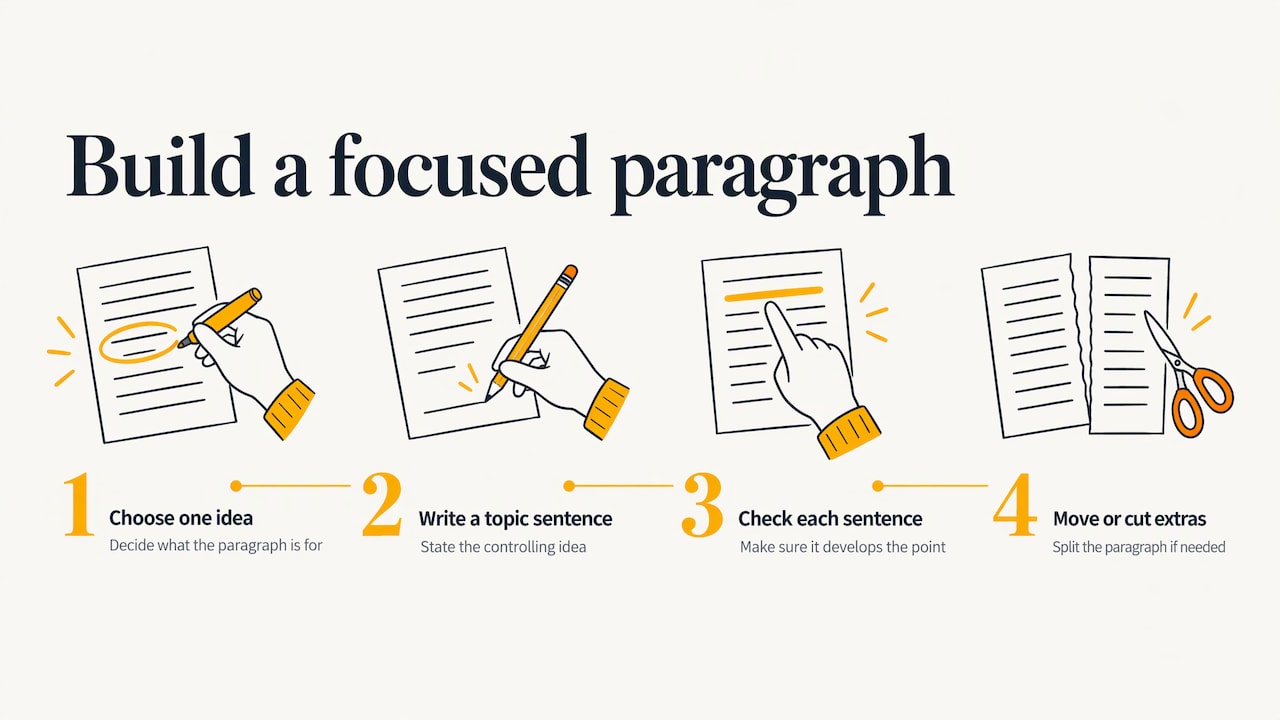
Most weak paragraphs fail before any sentence is written: the writer has not decided what the paragraph is for. The UNC Writing Center describes a paragraph as a group of sentences that support one controlling idea. Its advice is to decide that idea first and write it as a topic sentence. If a draft paragraph carries more than one main idea, delete the off-topic sentences or split it into separate paragraphs, each with one idea.
The Language Portal of Canada gives the same rule as a ratio: one idea to one paragraph. A quick test is to write the paragraph’s point in one short sentence in the margin. If you need the word “and” to join two different claims, you have two paragraphs.
A paragraph is also unified only when every sentence develops the point made in the topic sentence, according to the Language Portal of Canada’s HyperGrammar guide. Read each sentence and ask whether it belongs under that one claim. If it does not, move it or cut it.
The anatomy of a strong body paragraph
Once the idea is fixed, the paragraph needs a shape. Several university writing centers describe the same skeleton with different labels.
- PIE: Point, Illustration, Explanation. The Austin Peay State University Writing Center says to state the point as a topic sentence, add an illustration such as facts, examples, statistics or quotes, and finish with an explanation that connects the evidence back to the point.
- Topic sentence, evidence, analysis: the Harvard College Writing Center names these as the three elements of a body paragraph and advises ending with a takeaway sentence rather than a summary or a new, unsupported idea.
- The hamburger: Monash University likens the topic sentence to the top bun, the supporting sentences to the filling and the concluding sentence to the bottom bun, in its guide to building clear paragraphs.
The step writers skip most is the explanation. The UNC Writing Center is direct about it: no example should be left unexplained. A quotation, a statistic or an anecdote does not argue anything by itself. Your next sentence has to say what it shows and why it supports your point.
The five sentence jobs
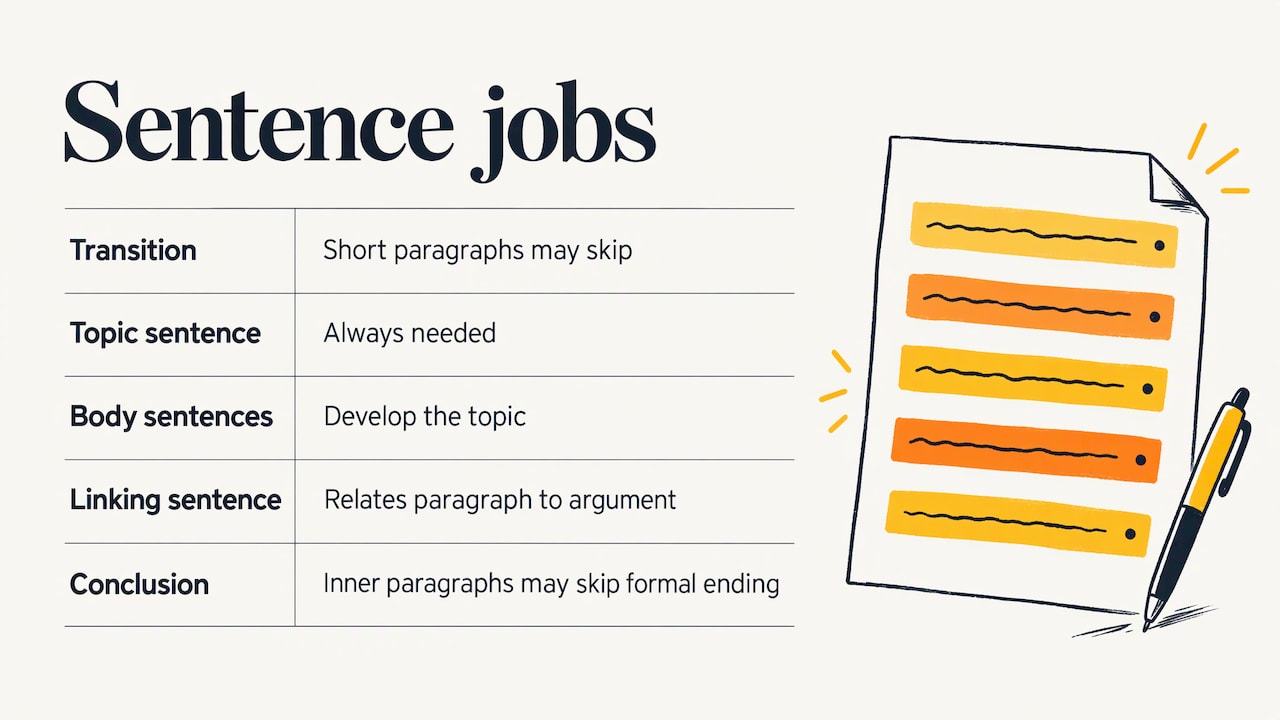
The University of Wisconsin–Madison Writing Center separates a paragraph’s sentences by function: transition, topic, body, linking and concluding sentences. Not every paragraph needs all five. A short paragraph may skip the transition, and an inner paragraph may skip a formal conclusion. What it always needs is a topic sentence and body sentences that develop it. A linking sentence, which relates the paragraph back to your main argument, is what stops a paragraph from feeling like an island.
How long should a paragraph be?
There is no fixed number, but the guidance from writing centers is consistent. The UW–Madison Writing Center suggests a first-draft goal of four to six sentences, enough to announce an idea, prove it and explain why the proof matters. The Language Portal of Canada recommends no more than five or six sentences. Purdue’s writing lab suggests checking paragraphs under four or over seven sentences to see whether they need expanding or splitting.
Treat those figures as signals, not laws. A very short paragraph can add emphasis in a final draft, but UW–Madison notes that too many short ones may suggest underdeveloped ideas. A very long one usually means two ideas are fused. Split at the point where the argument turns.
Choose a pattern that fits the point
A paragraph’s content often suggests its order. HyperGrammar describes three common patterns: development by detail (a general claim followed by specific illustrations), by comparison and contrast (point by point or subject by subject), and by process. MIT’s writing guide lists nine modes of development, including narration, description, analogy, cause and effect, classification, definition and analysis. It also notes that these patterns usually emerge during revision, and that a series of paragraphs may use more than one.
In practice:
| If your point is… | Try this pattern |
|---|---|
| A claim that needs proof | Detail: claim, example, explanation |
| Two options or positions | Comparison: point by point |
| A sequence of steps | Process: in time order |
| A problem and its effect | Cause and effect |
| A term your reader may not know | Definition, then an example |
The Language Portal of Canada adds that coherence comes from organizing by reason, time, space or importance. Pick one logic per paragraph and keep to it.
Make the sentences flow
A paragraph can have the right parts and still read as a pile of facts. The fix is not a handful of transition words. The Cornell Knight Institute warns against using transitions as band-aids over disjointed sentences. It teaches two habits instead.
- Topic strings: begin sentences with short, concrete, familiar subjects, so the reader always knows who or what the sentence is about.
- Stitching: let new information at the end of one sentence become the known information at the start of the next.
UW–Madison, citing Joseph Williams and Joseph Bizup’s Style: Lessons in Clarity and Grace, defines this kind of cohesion as the last few words of one sentence setting up the first few words of the next. Penn State’s revising guide shows the same old-to-new movement in a before-and-after paragraph, and lists three supporting tools: stock transitional phrases, clear pronoun reference and recycled key words.
UW–Madison also cautions that over-connecting ideas can sound patronizing. If the link between two sentences is obvious, leave it alone.
A worked example: before and after
Here is an invented draft paragraph of the kind many drafts contain:
Social media affects teenagers. It is used a lot. Many teenagers use it for hours. Sleep is affected. Teenagers also compare themselves to others. Schools should teach media habits.
The problems are easy to name. There is no clear controlling idea: sleep, comparison and schools all compete. The sentences are short and start with unrelated subjects. Nothing is explained.
Step one is to choose the idea. Say we pick sleep. Step two is to write a topic sentence, add one illustration and explain it. Step three is to link to the larger argument.
Late-night scrolling cuts into teenagers’ sleep, and that loss shows up in school. A student who checks a feed until midnight and wakes at six has fewer hours to rest than the school day assumes. That shortfall makes it harder to concentrate in first period, which is exactly when the most demanding classes often start. If schools want better focus, they should begin by teaching students to set limits on evening screen time.
Notice what changed. The topic sentence names one idea. Each sentence starts with something the previous one introduced (scrolling, a student, that shortfall, schools). The paragraph explains its example instead of dropping it, and the last sentence links to the wider argument. The example is illustrative: in a real essay you would add a cited source for any claim about sleep.
Reassemble a paragraph that will not work
When you cannot see what is wrong, change how you read it. The City University of New York Graduate Center Writing Center describes a reassembling exercise:
- Pick the unclear paragraph.
- Put each sentence on its own line.
- Print the lines and cut them apart.
- Shuffle them, then reassemble in topic sentence, evidence and analysis, conclusion order.
- Compare your version with the original.
- Enter the changes in your draft.
The center notes that jumbled text is psychologically easier to revise than text read straight through, and that the same method works on whole sections. Sentences that you cannot place anywhere are usually the off-topic ones to cut.
For a whole essay, the Cornell Knight Institute suggests a reverse outline, where you write down what each paragraph actually says and check the sequence. Our guides on how to evaluate essay structure and how to revise essays effectively take the same approach across a full draft.
Improve sentence structure inside the paragraph
Only after the content and order are settled should you polish sentences. The University of Texas at San Antonio Writing Center advises doing sentence- and word-level revisions after content and organization, and starting by reading the essay aloud. It also suggests placing important information at the start or end of a sentence, not the middle.
Fix awkward sentences
Northwestern University’s Writing Place says awkwardness usually arises when writers confuse clause types, sentence structures or parallel structures, and recommends two habits: read the sentence aloud and rephrase it the way you would explain it to a friend, and cut or replace unnecessary words. Its examples shrink “It is my opinion” to “I think”. The Dalhousie University Writing Centre lists wordy language, repetition, strange syntax, passive voice and nominalization as common causes. Nominalization means turning a verb into a noun, as in “make a decision” instead of “decide”.
Eastern Washington University offers a practical breath test. Read aloud, pausing only at punctuation: if you run out of breath, you may have a run-on sentence, and if you breathe too often, your sentences are short and choppy.
Fix repetitive or choppy sentences
OpenStax explains that sentence combining turns choppy drafts into smoother ones: join short, repetitive sentences into one with a compound subject or predicate, or into a complex sentence with a dependent clause. Purdue’s writing lab gives three fixes for sentences that keep repeating the same subject: embed one sentence in another with a relative pronoun, swap a be verb for a participle, or turn a sentence into a prepositional phrase.
Applied to our example: “Teenagers use social media for hours. Sleep is affected.” becomes “Hours of social media use eat into teenagers’ sleep.” Two weak sentences become one that carries the point.
The LibreTexts Writers’ Handbook gives a measurable rule: within a paragraph, avoid starting more than two sentences with the same word. It also says too many short sentences read as simplistic and too many long ones as convoluted, so mix lengths. Our guide to sentence variety goes deeper on rhythm.
Penn State adds two more rules. Use subordination to show which idea matters more (“Although production costs have declined, they are still high”), and use parallel structure so that grammar mirrors meaning.
Repetition is not always a flaw. Whitman College’s Center for Writing and Speaking notes that repeating words can be a deliberate tool for emphasis and transitions, so mark repeated words first, then decide which ones to replace. Often a pronoun is enough.
When you tighten a sentence you are often condensing it, and knowing summarizing versus paraphrasing helps you decide how much of the original idea to keep. For grammar points that trip up academic writers, see our guide to academic grammar rules.
A revision checklist you can reuse
Run each paragraph through these questions, in order:
- Can I state the paragraph’s point in one sentence?
- Does the topic sentence appear early and make a claim?
- Is every example followed by an explanation?
- Do all sentences belong to that one idea?
- Does each sentence start from something the reader already knows?
- Does the last sentence complete the idea or lead to the next paragraph?
- Read aloud: where did I stumble, run out of breath or hear the same word twice?
The University of New Hampshire’s self-editing guide adds a useful habit: take a break before editing, then read aloud to catch awkward phrasing and redundancies. Judging your own draft honestly is a skill in itself, and our page on writing self-assessment covers it.
If you are preparing for IELTS or TOEFL
Timed exam essays reward exactly this structure: a clear topic sentence, a developed point and a link to the question. With only minutes to plan, decide each paragraph’s one idea before you write it, and leave a minute at the end to read for repeated openings. Our IELTS writing practice plan shows how to build that routine toward a higher band.
Get paragraph-level feedback with Writing Lab
The routine above works, but it depends on you spotting your own blind spots. Writing Lab is an AI-powered platform with tools for writing feedback, grammar checking, rewriting and IELTS and TOEFL practice, and it has a free access tier. You can paste a paragraph, see where it drifts or repeats, and revise it. Teachers can use the same platform for AI essay grading, so structure comments reach students faster. Start at Writing Lab.

Our perspective
Paragraph structure is where most writers actually improve. Grammar errors are easy to point at, but a reader who loses the thread of an argument rarely knows why. In our view the fix is a repeatable routine: one idea, one claim, evidence that is explained, and a sentence that carries the reader on.
That is why we built Writing Lab around feedback, not just correction. Our tools cover grammar checking, writing feedback, rewriting and essay grading, so a student, a professional or a teacher can look at a paragraph and see what to change next. For teachers, we aim to cut the time spent on repetitive marking so more of it goes into teaching.
Use the checklist above on your next draft, then let the tools show you the patterns you miss on your own.
Sabba
FAQ
How do I structure a paragraph?
Start with a topic sentence that states one main idea. Add evidence such as an example, data or a quotation, explain how it supports the idea, and end with a sentence that completes the thought or leads to the next paragraph. The PIE method (point, illustration, explanation) is an easy way to remember it.
How long should a paragraph be?
A first-draft target of four to six sentences works for most academic writing, according to the UW–Madison Writing Center. In revision, split any paragraph that holds two ideas and expand one that states a point without proving it.
How do I fix awkward sentences?
Read them aloud and mark where you stumble. Then cut unnecessary words, put the important information at the start or end of the sentence, and check for passive voice, nominalizations and mismatched parallel structure. Rephrasing the sentence as if you were explaining it to a friend often solves it.
How do I improve sentence variety?
Combine short sentences with a dependent clause or compound predicate, and vary the way you open sentences with adverbs, phrases or subordinate clauses. Avoid beginning more than two sentences in a paragraph with the same word, and mix short and long sentences.
Sources
- Paragraphs, UNC Writing Center
- Developing unified and coherent paragraphs, HyperGrammar 2
- Clear communication: Polish your paragraphs, Writing Tips Plus
- PIE Paragraph Method Handout, Austin Peay State University
- Anatomy of a Body Paragraph, Harvard College Writing Center
- Build clear paragraphs, Monash University
- Improve Your Paper by Writing Structured Paragraphs, UW–Madison Writing Center
- Approaching Revision, Purdue OWL
- Paragraph Development, MIT
- How to Flow!, Cornell Knight Institute
- Connecting Ideas Through Transitions, UW–Madison Writing Center
- Strategies for Revising Academic Writing, Penn State
- Sentences and Paragraphs out of Order?, CUNY Graduate Center Writing Center
- Sentence and word-level revisions, UT San Antonio Writing Center
- Fixing Problems that Lead to Awkward Sentences, Northwestern Writing Place
- Awkward phrasing handout, Dalhousie University Writing Centre
- Revising, Editing, and Proofreading, Eastern Washington University
- Editing Focus: Sentence Structure, OpenStax
- For Repeated Subjects or Topics, Purdue OWL
- Using a Variety of Sentence Formats, LibreTexts Writers’ Handbook
- Sentence-level Repetition, Whitman College Center for Writing and Speaking
- Guide to Self-Editing, University of New Hampshire
- Summarizing vs. Paraphrasing: Differences and When to Use Each