TOEFL Writing Practice for the 2026 Test: Tasks, Timing, Feedback
The fastest way to improve on TOEFL Writing is to practice the three tasks the test now contains, under the real time limits, and to get each response checked against the official scoring guide. Many practice sets still teach the old integrated essay, which is no longer on the test. At Writing Lab we build AI-powered writing feedback and IELTS and TOEFL practice tools so that every timed response you write comes back with feedback you can act on.
WritinglabPractice TOEFL Writing With FeedbackWriting Lab combines TOEFL practice tools with AI-powered feedback to help you review responses and improve your writing.Visit
TL;DR
- Since January 21, 2026, the Writing section has 12 items in about 23 minutes: Build a Sentence, Write an Email and Write for an Academic Discussion.
- The summary of reading and listening material (the old integrated essay) is gone. Practice material built around it trains the wrong skill.
- Time every drill: 7 minutes for an email, 10 minutes for a discussion post.
- Improvement comes from feedback. Score each response against the official guide, log your errors and fix one pattern at a time.
- A simple weekly rhythm beats occasional long sessions.
Table of Contents
- What the TOEFL Writing section looks like now
- Practice the tasks that exist, not the ones that left
- Build a Sentence: practice for accuracy
- Write an Email: practice for purpose and tone
- Write for an Academic Discussion: practice for a supported position
- Questions to practice with
- Use the scoring guide to find your weaknesses
- Structure that improves scores
- A weekly plan you can follow
- Where Writing Lab fits into your practice
- Our perspective
- FAQ
- Sources
What the TOEFL Writing section looks like now
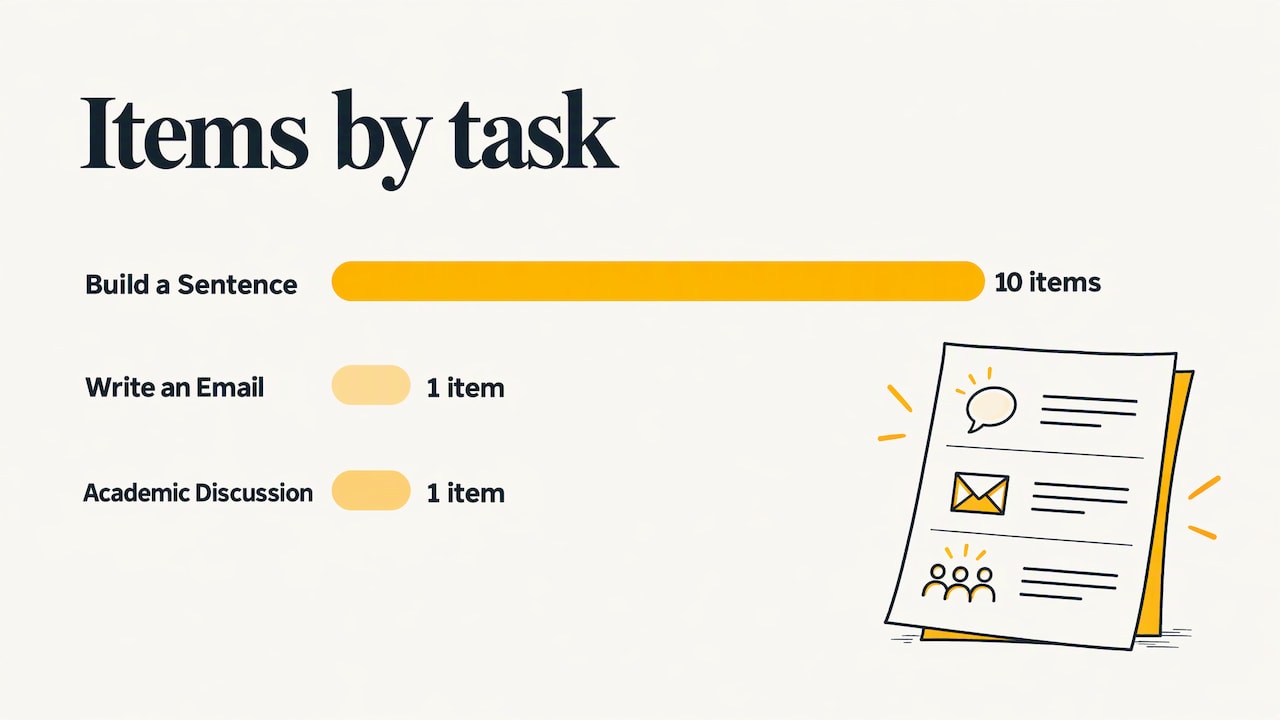
According to ETS’s 2026 test specifications, Writing has 12 items and takes an estimated 23 minutes. There are 10 Build a Sentence items, one Write an Email item and one Write for an Academic Discussion item.
From January 21, 2026, ETS describes the updated TOEFL iBT as the same trusted test with more modern content and topics closer to academic life. It is still offered at test centers and at home.
Here is each task at a glance:
| Task | What you do | Time | Scoring |
|---|---|---|---|
| Build a Sentence | Put scrambled words into a correct reply sentence | Part of the roughly 23 minutes in total | Machine-scored, up to 1 point per item |
| Write an Email | Respond to a scenario with a clear purpose | 7 minutes | 0 to 5 |
| Write for an Academic Discussion | Add your own post to a professor’s question and two classmates’ replies | 10 minutes, at least 100 words recommended | 0 to 5 |
The two longer tasks are scored by a mix of AI and trained human raters. ETS’s Test Prep Planner adds that raters treat responses as first drafts, so a high score is possible even with some errors. You do not need perfect prose. You need a complete, clear, well-organized response.
How scores are reported
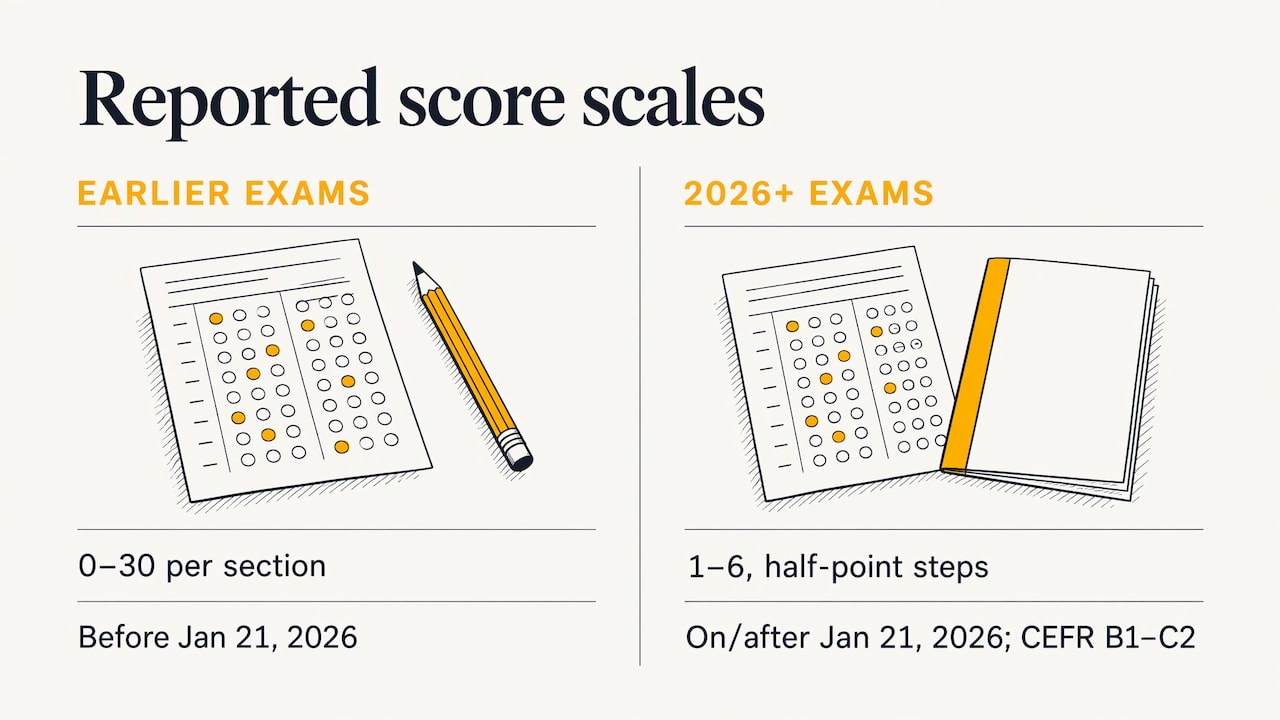
For exams taken on or after January 21, 2026, scores run from 1 to 6 in half-point steps, aligned to CEFR levels B1 to C2. Earlier exams used a 0 to 30 scale for each section. Check your target university’s requirement in the scale it now uses, because admissions pages are updated on their own schedule.
Practice the tasks that exist, not the ones that left
If your prep book or online set asks you to read a passage, listen to a lecture and then write a 20-minute summary, it is built for the pre-2026 test. Those sets are still useful for general academic writing, but they should not take up your limited prep hours.
ETS’s own older practice questions show the difference. One set asks for a 20-minute response of 150 to 225 words, which is a different job from a 10-minute discussion post. Build your drills around the three current formats instead.
Build a Sentence: practice for accuracy
This task rewards grammar control more than creativity. ETS’s lesson plan describes it as measuring command of the sentence structures that all written communication relies on. In the official overview, a typical item asks you to reorder words such as “the tour guides who showed us around the old city were fantastic” so that they answer a speaker’s question.
How to drill it:
- Find the verb and its subject first. Everything else hangs from them.
- Look for clause markers (who, which, that, because) and attach them to the noun or verb they modify.
- Check word order for questions, negatives and embedded questions, the usual trouble spots.
- Say the finished sentence aloud. If it sounds wrong, one of the small words is out of place.
Ten short items add up, because each is worth a point and none needs an essay. Work through batches of ten in a few minutes and keep a list of the structures you miss. Our guide to academic grammar rules covers the ones that matter most, and sentence variety helps once accuracy is steady.
Write an Email: practice for purpose and tone
You get a short scenario in an academic or social setting and seven minutes to write. The goal is a specific communicative purpose, such as making a recommendation, extending an invitation or proposing a solution. ETS’s sample asks the test taker to email a poetry magazine editor about a problem with a submission form.
The scoring guide gives a 5 to a response with effective elaboration, varied syntax, precise idiomatic word choice, consistent social conventions (politeness and register) and almost no errors beyond typos expected under time pressure. The same document shows a sample email that scored 4 because of consequential verb-tense errors, so tense control matters even when the message is clear.
A workable seven-minute shape:
- Minute 1: read the prompt and underline every goal (tell, describe, ask). Each one needs its own sentence or two.
- Minutes 2 to 6: write a greeting, a one-line reason for writing, one short paragraph per goal and a polite close.
- Minute 7: reread for verb tense and register. Replace casual words with neutral ones.
Researchers writing on the ielts.org site note that the task’s “write as much as possible” framing can reward length. Still, the rubric rewards fulfilling every goal with specific detail, so aim for complete and relevant rather than padded.
Write for an Academic Discussion: practice for a supported position
You read a professor’s question and two students’ posts, then add your own contribution in 10 minutes. ETS recommends at least 100 words, and the professor’s question and the classmates’ answers stay on screen the whole time, so you can keep checking them.
The Prep Planner advises you to state your opinion, support it with evidence, elaborate so the reader understands your position and why, and write in your own voice. In practice:
- Read both classmate posts for a gap. Agree with one and add something new, or disagree and say why. Repeating what they said earns little.
- Pick a position in under a minute. Choose the side you can support with two concrete ideas, not the side you believe most.
- Write a direct opening sentence that answers the professor’s question.
- Give one reason with a specific example, then a second shorter reason or a response to a classmate.
- Finish cleanly with a sentence that ties back to your position. Do not start a new idea at the end.
The Prep Planner suggests timing each practice post at 10 minutes to write and revise, brainstorming a couple of ideas first and leaving time to fix flaws. Make a list of familiar topics (technology in class, group work, part-time jobs, campus rules) and write at least one timed post per topic. Reusing the same vocabulary across familiar topics is a feature, not a flaw.
Questions to practice with
Start with ETS’s official materials: the test overview includes sample tasks for each type, with scoring commentary. Then widen the pool by writing your own prompts in the same pattern:
- Build a Sentence: take any short question-and-answer exchange and scramble the reply.
- Email: invent scenarios with a clear aim, such as asking a professor for an extension, reporting a lab booking error or recommending a study group to a new student.
- Academic Discussion: take a debate-style question about education or campus life, write two imaginary classmate posts that disagree, and answer them.
Match the format closely and the number of questions you can generate is unlimited. What is scarce is feedback on your answers, and that is where most learners stall.
Use the scoring guide to find your weaknesses
ETS’s Prep Planner gives a clear routine for turning practice into progress:
- Read sample responses and the raters’ comments to place your own level.
- Use the official 0 to 5 scoring guides for Email and Academic Discussion to see what each score requires.
- Keep a personal checklist of recurring errors, such as verb tenses, run-on sentences and subject-verb agreement.
- Reread your writing three or four times, checking for something different on each pass.
- Replace weak words like “get,” “nice” and “stuff” with more precise ones.
- Practice transitions such as “on the one hand” and “in conclusion.”
The planner also recommends having an English teacher or tutor evaluate your writing against the official rubrics. That works best when the feedback is quick and specific. A comment that says “improve your grammar” does nothing. A comment that says “you switch between past and present in the second paragraph” gives you something to fix in the next drill.
For a self-check habit that supports this, see our guide to judging your own draft.
A short error log that works
After each response, write three lines: the score you would give it against the guide, the one error type that cost you most, and the single fix you will apply next time. Review the log weekly. Patterns appear quickly, and most learners find that two or three error types account for most of their lost points.
Structure that improves scores
The Prep Planner points to clear topic sentences, one main idea per paragraph, logical verb tenses and transitions. It also frames planning and basic conventions (spelling, punctuation, paragraphing) as the base to build on before targeted practice.
There is evidence that teaching structure explicitly pays off. A 12-week classroom study at a US university reported that average scores for topic sentences and thesis restatement rose by 1 and 1.7 points, with most of the gain between the first and second assignments. The lesson for your prep: learn the structure early and intensively, then spend the remaining weeks on accuracy and speed.
A weekly plan you can follow
The Prep Planner organizes preparation into weekly tasks, and you can mirror it:
| Day | Focus | Time |
|---|---|---|
| 1 | Review the scoring guide and one sample response at your target level | 30 minutes |
| 2 | Three batches of Build a Sentence items, then log misses | 20 minutes |
| 3 | Two timed emails (7 minutes each), then score and revise | 40 minutes |
| 4 | Two timed discussion posts (10 minutes each) on familiar topics | 40 minutes |
| 5 | Rewrite your weakest response from the week using your error log | 30 minutes |
| 6 | One full run: ten sentences, one email, one discussion post, timed back to back | 30 minutes |
Once a week, check each answer against the questions ETS suggests: Did I complete the task? Did I write clearly? Did I organize my ideas coherently? Track your self-scored results across weeks. A slow, steady rise is the signal you want, and a plateau tells you which error type to attack next.
If you are also preparing for IELTS, the skills overlap, though the tasks differ. Our IELTS writing practice plan shows how to structure that preparation.
Where Writing Lab fits into your practice
Timed writing only helps when you can see what went wrong. Writing Lab is an AI-powered platform that offers essay grading, writing feedback, grammar checking and IELTS and TOEFL practice, with a free access tier and paid monthly or yearly plans. You can write your email or discussion post, receive feedback and use it to update your error log the same day, instead of waiting for a tutor’s next session.
Teachers preparing groups for the test can use the same tools to assess student work and cut marking time. Our overview of AI grading for essays explains how that works. To start practicing, visit Writing Lab.

Our perspective
Most TOEFL writers do not lack effort. They lack a short loop between writing and learning what to change. A response written on Monday and judged on Friday has already faded from memory.
We built Writing Lab around that loop: write, get specific feedback on grammar and structure, revise, repeat. For students that means personalized guidance on their own errors. For teachers it means less time marking and more time teaching.
The 2026 TOEFL rewards exactly this kind of practice. Tasks are short, the scoring criteria are public, and progress comes from fixing recurring patterns one at a time. Our aim is to be the place where that practice happens.
Sabba
FAQ
How long should I practice TOEFL writing each week?
About three to four hours spread over several days works for most learners, following the weekly plan above. Short, frequent sessions with review beat one long session. Adjust upward if your test date is close.
Is the integrated essay still on the TOEFL?
No. From January 21, 2026, Writing consists of Build a Sentence, Write an Email and Write for an Academic Discussion. Summarizing a reading and a lecture is no longer tested, so focus your timed drills on the three current tasks.
How many words should my academic discussion post have?
ETS recommends at least 100 words for the 10-minute post. Aim a little above that with a clear position, one developed reason with an example and a short second point. Quality of support matters more than hitting a high count.
How do I get feedback on my TOEFL writing?
Score each response against ETS’s official 0 to 5 guides, keep an error log and have it reviewed by a teacher or an AI feedback tool that comments on grammar, organization and task completion. Writing Lab offers writing feedback and grammar checking for exactly this purpose.
Sources
- TOEFL iBT Test: 2026 Update (ETS test specifications)
- Updated TOEFL iBT Test Overview (ETS)
- Getting Better! Updates flyer for students (ETS)
- TOEFL iBT Test Prep Planner (ETS)
- TOEFL iBT Lesson Plans: Writing (ETS)
- TOEFL iBT Writing Practice Questions (ETS)
- Comparing New TOEFL 2026 with Former TOEFL 2023 and IELTS (ielts.org)
- TOEFL scoring page, University of Cagliari
- Reconceptualizing the Teaching of the Five-Paragraph Essay (eScholarship)